Thermal Insulation on Metal: The Infrared Test on Maris Tech
Thermal Insulation on Metal: The Infrared Test on Maris Tech
Initial Summary
Thermal insulation on metal should be assessed not only according to the applied thickness, but also according to its ability to reduce heat transfer under conditions of intense radiation. For this reason, we carried out a demonstration test on an aluminium sample treated with approximately 1 mm of Maris Tech, exposed to an infrared lamp and analysed with a thermal imaging camera. The comparison between the non-insulated surface and the treated surface shows a clear thermal difference and helps explain the product’s behaviour on metal substrates.
By Eng. Elena Galeotti – 14/05/2026
Brief Contents
- Why test insulation on metal
- How the test was carried out
- The results detected with the thermal imaging camera
- Where Maris Tech can be used
- FAQ
Why Test Thermal Insulation on Metal
Metal surfaces are widely used in the marine sector. However, metal has a very specific characteristic: it tends to transmit heat rapidly.
This means that a metal sheet exposed to an intense heat source can reach high temperatures in a short time, transferring heat towards the internal environment or to the opposite surface. In many applications, this phenomenon can create problems related to comfort, energy loss, condensation.
In these cases, a low-thickness thermal insulation coating for metal can represent an interesting solution, especially when traditional panels cannot be applied or when reduced overall dimensions must be maintained.
The Infrared Lamp Test on Aluminium
This technical test was carried out on an aluminium sample treated with approximately 1 mm of Maris Tech. One sample was exposed to an infrared lamp, used as a concentrated heat source, and the surface temperatures were measured using a thermal imaging camera.
The aim of the test was not to replace a certified laboratory test, but to visually and immediately show the behaviour of the coating when applied to a metal substrate subjected to intense radiation.
The test compared:
- a non-insulated metal surface;
- a metal surface treated with Technological M;
- the behaviour of the sample by reversing the position of the heat source;
- the temperature measured on the rear side of the substrate.
Results Detected with the Thermal Imaging Camera in the Test on Maris Tech Thermal Insulation for the marine industry
In the first scenario, the heated surface without insulation reached approximately 153°C. The part treated with approximately 1 mm of Maris Tech on the other hand, did not reach 47°C, showing a very significant reduction in the temperature measured on the opposite surface.
Maris Tech thermal insulation for metal tested with an infrared lamp and thermal imaging camera, first part of the test
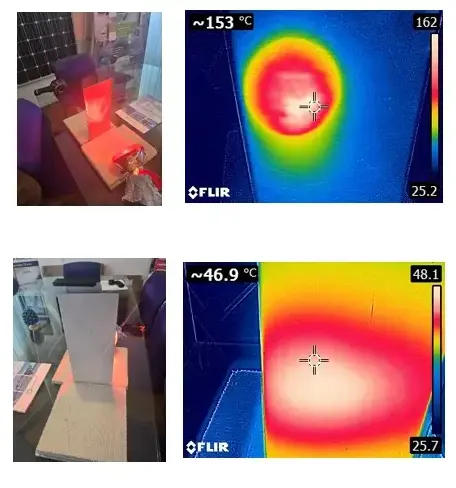
The heated surface without insulation reaches 153°C, while the insulated area does not reach 47°C, reducing heat transfer by more than 100°C.
Maris Tech thermal insulation for metal tested with an infrared lamp and thermal imaging camera, second part of the test
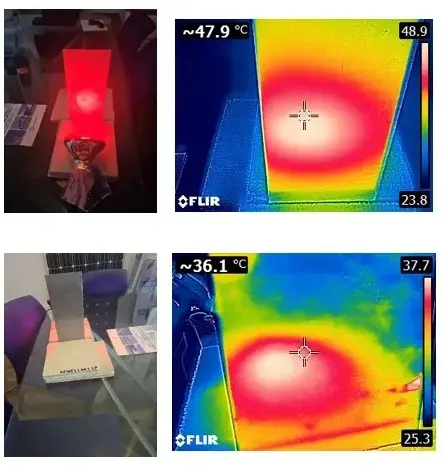
By reversing the position of the heat source, the insulated area does not reach 48°C (compared with 153°C in the previous case), while the rear side drops to just over 36°C.
By reversing the position of the heat source, the insulated part did not reach 48°C, while the rear side dropped to just over 36°C.
These data, referring to the specific test carried out, show how the coating can help reduce thermal transfer through a metal surface. It is important to emphasise that the result may vary depending on several factors: type of substrate, applied thickness, application method, intensity of the heat source, exposure duration and environmental conditions.
For this reason, every industrial intervention should be assessed on a case-by-case basis, starting from the actual operating conditions.
Why Maris Tech Is Suitable for Metal Surfaces
Maris Techis a low-thickness nanocomposite liquid coating developed for thermal insulation and surface protection in the marine industry. Its formulation contains microscale vacuum ceramic microspheres and works mainly thanks to the thermo-reflective capacity of the coating.
Maris Tech can be applied on metals, concrete, wood, PVC, plastics, natural stones and sheet metal. The thickness is approximately 1.0–4.0 mm, with a coverage of about 1 litre per 1 m².
Other important technical data are:
- Thermal conductivity: λd = 0,0010 W/mK
- Thermal reflectance (SR %) (ASTM C1549): 91.0
- Thermal emissivity (IE %) (EN 15976): 90.0
- Thermal reflectance index (SRI %) (ASTM E1980): 115.3
- Ph: 8,5 (± 0,5) VOC content: 1 gr/lt
- Finish/color: White (can be colored with pastel colors)
- Viscosity: 7500 cps Density: 370 kg/m3 approx.
- Reaction to fire: Euro Class A – MED Certification
- Water permeability w: 0.08 kg/m (E1062-3)
- Pull-off test: > on substrate 0.55 ± 0.10 mmlyer over layer (ASTM 541) Drying time for each coat: 8 h
Maris Tech in MED – SOLAS – IMO – MSC certified for marine application (N° 0497/1809)
Importance of Correct Application of thermal insulation on metal
The performance of a technical coating always also depends on the quality of the application. Regarding the substrate, it must be clean, dry and properly prepared.
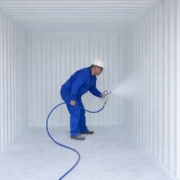
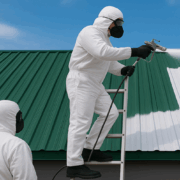
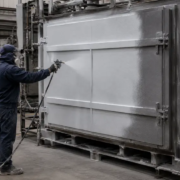
The application is possible in several coats, preferably using an airless sprayer, while respecting the drying times of each coat. </p>
This aspect is fundamental: a good product must always be accompanied by a proper analysis of the substrate and by application carried out according to the technical instructions.
FAQ – Thermal Insulation on Metal
Is the infrared lamp test a certification?
No. It is an internal demonstration test, useful for visualising the thermal behaviour of the product on a metal sample. It does not replace certified laboratory tests or specific design assessments.
What thickness was applied to the sample?
In the test, approximately 1 mm of Maris Tech was applied. Generally speaking, Maris Tech has a thickness of 1,0-4,0 mm, depending on the theraml insulation level required.
Can Maris be applied directly onto metal?
Yes, it can be applied on metal surfaces, subject to verification of the substrate. Surface preparation is essential to ensure adhesion and coating durability.
Where can thermal insulation on metal be useful?
It can be assessed for cabins, internal hull walls, ceilings and suspended ceilings, engine rooms, technical rooms, cargo holds, areas with complex geometries, and surfaces exposed to temperature fluctuations and humidity (thermal bridges).
Conclusion
The infrared lamp test on aluminium immediately shows the behaviour of Maris Tech applied at low thickness on metal. The difference between the non-insulated surface and the treated surface highlights the potential of the coating in industrial contexts where heat control is a relevant technical issue.
To assess the use of Maris Tech on metal surfaces you can contact us for more information at info@savenergy.it.
 Follow our facebook for video, case history and much more!