
Low-Thickness Marine Insulation: How Maris Tech Solves the Trade-Off Between Thermal Performance, Weight, and Bulk
Initial Summary
Low-thickness marine insulation is becoming an increasingly important choice for shipyards, designers, and boat owners who want to improve onboard comfort without penalizing weight, internal volume, or installation speed. In this context, Maris Tech stands out because it makes low-thickness marine insulation possible in just a few millimetres, while also helping to control condensation in marine environments and supporting the long-term protection of metal structures. This is not simply about insulating against heat and cold. It is about solving a real design challenge: improving performance without introducing the typical drawbacks of bulkier insulation systems.
Quick Index
- Why weight and bulk matter so much in the marine sector
- The limits of traditional insulation in cabins and technical spaces
- How Maris Tech works
- Technical benefits for comfort and structural protection
- Where to apply it in new builds and refits
- FAQ
The Real Challenge Is Not Just Insulating, but Doing It Without Compromising the Design
In the marine sector, every millimetre counts. Cabins, bulkheads, ceilings, technical rooms, engine rooms, and internal compartments all require solutions that improve thermal performance without reducing usable space or adding unnecessary weight to the vessel. That is exactly why low-thickness marine insulation has become such a central topic.
Traditional insulation materials may offer good performance, but they often involve greater thickness, more complex construction details, and more difficult installation in irregular or hard-to-reach areas. In marine applications, this creates a clear design conflict: improving insulation can mean sacrificing space, increasing weight, or complicating the production process.
Maris Tech was developed to overcome this limit with a different approach. It is a nanocomposite insulating coating specifically designed for marine use, spray-applied and able to work at indicative thicknesses of approximately 1 to 4 mm.
Low-thickness marine insulation Maris Tech: Thermal Performance in Just a Few Millimetres
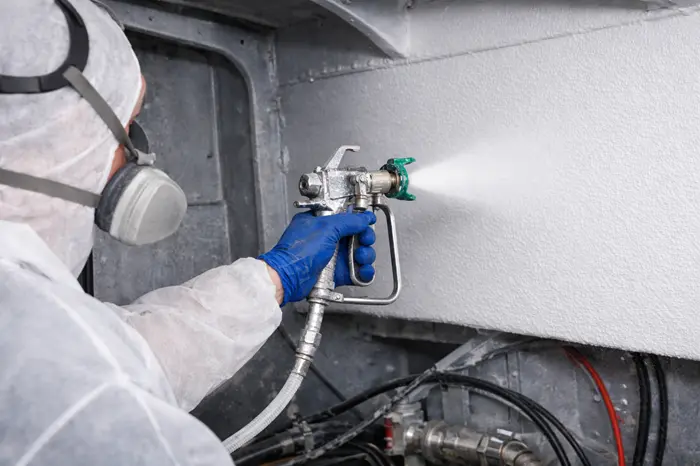
Spray application of Maris Tech on an internal metal surface: a solution for low-thickness marine insulation.
Maris Tech is a water-based, solvent-free protective thermal and waterproofing coating developed for the interior insulation of boats, yachts, ferries, and ships. Its formulation, based on microscopic vacuum ceramic spheres, helps reduce thermal load and creates a continuous barrier directly on internal surfaces.
This point is essential. When discussing low-thickness marine insulation, coating continuity makes a real difference because it also helps treat complex areas, irregular geometries, reinforcements, and surfaces that are difficult to manage with rigid boards or bulky insulation packages.
From a technical perspective, Maris Tech offers particularly relevant features for marine applications:
- indicative application thickness from 1 to 4 mm
- density of approximately 370 kg/m³
- water-based formulation
- very low VOC content
- Euroclass A1 fire reaction and MED certification
- good adhesion on different substrates
- anti-condensation function
- effective thermal insulation designed for long-term performance without ordinary maintenance requirements
Less Weight, Less Bulk, and Better Structural Protection
Reducing weight and bulk does not only mean gaining internal space. It also means limiting the impact of the insulation system on the overall vessel design, simplifying some processing stages, and more easily preserving construction balance.
But there is a second aspect that is often even more important: long-term structural protection. In marine environments, especially where there are hulls or internal metal surfaces, condensation is a critical factor. When internal surface temperature drops to the dew point, surface moisture forms. Over time, this phenomenon may contribute to corrosion, finish deterioration, mould growth, and lower onboard comfort.
Maris Tech helps stabilise internal surface temperature and reduce the risk of condensation. For this reason, low-thickness marine insulation should not be seen only as a comfort choice, but also as a technical measure for protecting the structure, particularly interesting both in new construction and refitting projects.
Why Low-thickness marine insulation is a Practical Advantage for Shipyards and Refitting Projects
Another strength of Maris Tech is its application method. The product is preferably applied with an Airless system, in one or more coats, directly on the internal iron parts of the hull and on internal walls, before the subsequent finishing cycles.
This makes the solution particularly attractive when the project requires:
- fast installation
- coating continuity
- treatment of articulated surfaces
- thickness control
- reduced invasive work
For shipyards and refit professionals, this means working with a technology designed to fit effectively into real production and refurbishment cycles, without introducing bulky insulation layers.
Where Maris Tech Can Make a Difference
Maris Tech can be considered for several areas of a vessel, including:
- internal hull walls
- cabins
- partitions and bulkheads
- technical compartments
- condensation-prone rooms
- areas where available space is limited
In all these cases, the objective remains the same: achieving low-thickness marine insulation that contributes to thermal comfort, moisture management, and surface protection without adding excessive bulk.
FAQ about Low-thickness marine insulation Maris Tech
Is Maris Tech suitable only for new vessels?
No. It is an interesting solution both for new builds and for refitting projects, especially when insulation needs to be improved without introducing significant thickness.
What is the main advantage over traditional insulation of Low-thickness marine insulation Maris Tech?
The main advantage is the possibility of working within just a few millimetres, with spray application and a continuous coating that helps limit weight, bulk, and installation complexity.
Besides thermal comfort, what other benefits does Maris Tech offer?
Maris Tech can help reduce condensation on internal surfaces and therefore support the long-term protection of both the structure and the finishes.
What thickness is typically applied?
Indicatively, from about 1 to 4 mm, depending on the required application cycle.
Conclusions
Choosing a low-thickness marine insulation system today means addressing one of the most concrete challenges in modern marine design in a smarter way: improving thermal performance without unnecessarily increasing weight and bulk. Maris Tech answers this need with a technology specifically developed for the marine sector, applicable in just a few millimetres and designed to provide comfort, condensation control, and long-lasting structural protection.
For more information about Maris Tech and its possible applications in your marine project, contact us at info@savenergy.it
Eng. Elena Galeotti – 20/04/2026

