Dairy Industry Piping: Why a Low-Thickness Thermal Coating Can Make a Difference
Dairy Industry Piping: Why a Low-Thickness Thermal Coating Can Make a Difference
Summary: in the dairy industry, the thermal management of piping affects process efficiency, condensation control, and operational continuity. A thermal coating for dairy piping can be an interesting solution when low thickness, fast application, and adaptability to complex lines, bends, valves, and metal surfaces are required. Savenergy.it products are nanotechnology-based thermal insulation solutions for industrial applications, specifically designed for interventions on piping, tanks, containers, cold rooms, and other technical surfaces.
Summary Index
- Why piping is a critical point in dairy plants
- Heat loss, condensation, and limited space
- The advantage of low thickness
- Where a thermal coating can be useful
- FAQ
Why piping is a critical point in dairy plants
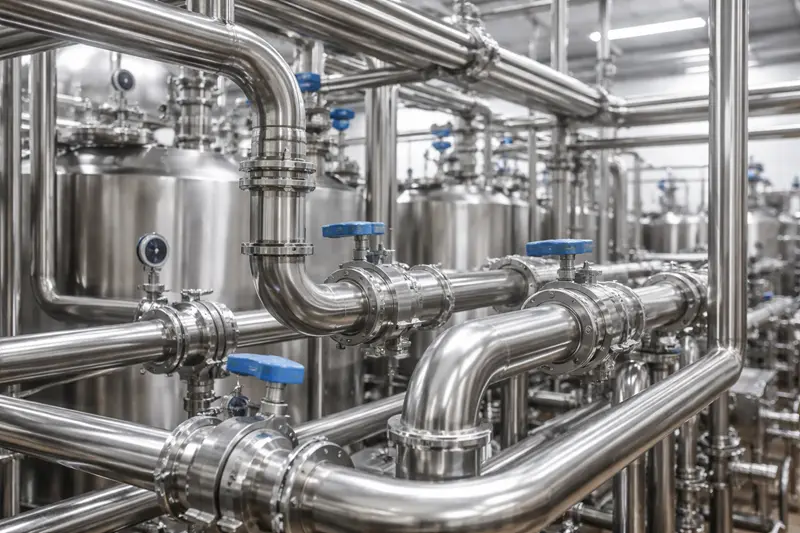
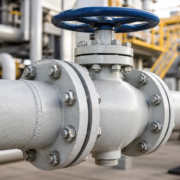
Industrial stainless steel pipes and valves in a dairy facility with Thermal Coating for Dairy Piping applications.
In the dairy sector, piping is not just a connection element between machines and tanks. It carries milk, hot water, chilled water, service fluids, and cleaning solutions, directly contributing to the stability of the production process. For this reason, insulating the lines can become a significant technical issue.
In this context, a thermal coating for dairy piping makes it possible to intervene on metal surfaces that often operate in environments where temperature, humidity, and frequent washdowns put materials under severe stress. Savenergy.it products are low-thickness nanotechnology-based thermal insulating coatings designed for industrial applications on piping, metal equipment, tanks, and cold rooms.
Heat loss, condensation, and limited space often make a thermal coating for dairy piping necessary
In dairy processing lines, heat loss can increase energy consumption and make it more difficult to maintain the desired operating conditions. Another important aspect is surface condensation, which in many production environments represents a critical issue that must be carefully monitored.
This is where the issue of thermal coating for dairy piping comes into play. When piping runs through technical areas, narrow passages, or zones with bends, flanges, supports, and valves, traditional high-thickness insulation systems are not always the most practical solution. Savenergy.it products are specifically designed to provide industrial thermal insulation with reduced thickness, anti-condensation performance, and airless spray application, a feature that is especially useful when plant geometry is complex.
The advantage of low thickness for a thermal coating applicable to dairy piping
In a dairy plant, the challenge is not only to insulate, but to insulate without making the system more complicated. Where there are closely spaced lines, valves, fittings, and sections that are difficult to cover, bulkier systems may become less practical.
Here, low thickness represents a real operational advantage. AES TECH is a semi-liquid nanocomposite solution for industry, applicable directly onto metal after substrate preparation, with installation recommended in multiple coats by airless spray. Its limited thickness, from 1 to 4 mm, makes it possible to consider the intervention even where line geometry makes traditional insulation more difficult.
Manti Ceramic Technological M follows the same application logic, with an indicative thickness of 0.6–2.0 mm, making it an interesting option when thermal protection and reduced bulk are required on metal and technical surfaces.
Which technical data are really relevant for a thermal coating for dairy piping
When evaluating a solution for insulating piping in the dairy industry, some data are more useful than others.
For AES TECH:
- application thickness: 1.0–4.0 mm
- fire reaction: Euroclass A
- VOC content: < 0.003 μg/l (UNI EN ISO 16000-9:2024, 160000-6:2021, 16000-3:2022)
- industrial application also on piping, containers, silos, metal equipment, tanks, and cold rooms
These data are important because they help show that the product fits into a different logic compared to traditional high-thickness insulation materials. The conductivity of 0.001 W/mK highlights the possibility of working with very limited thicknesses on metal substrates and industrial systems.
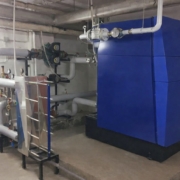
Industrial piping in a food environment, with some lines treated with AES TECH, a low-thickness solution also suitable for bends, valves, and fittings.
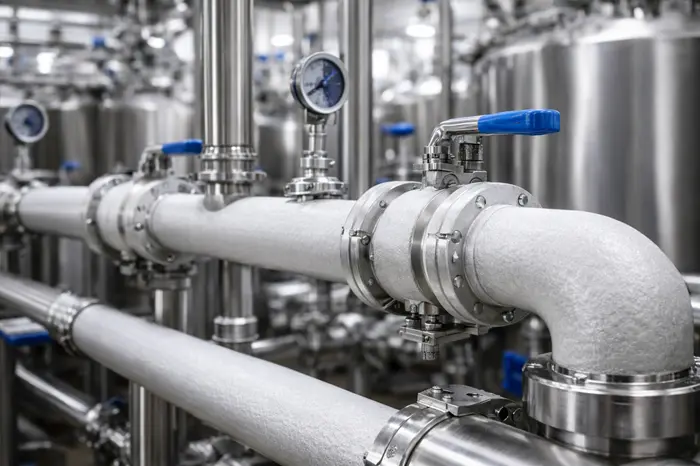
Industrial piping in a food environment, with some lines treated with AES TECH, a low-thickness solution also suitable for bends, valves, and fittings.
Where a thermal coating can be useful
In the dairy industry, a system of this type may be considered for:
- metal process piping;
- hot/cold service lines;
- sections with bends, joints, and valves;
- technical surfaces where low thickness is a priority;
- plants where the bulk of the insulation must be kept to a minimum.
Savenergy.it products are water-based thermal protective coatings, formulated for industrial applications and characterized by good adhesion on various surfaces.
A technical choice to be evaluated case by case
In dairy plants, there is no single solution suitable for every line. Operating temperatures, washdowns, production cycles, the existing substrate, and accessibility all influence the choice. For this reason, it is useful to evaluate materials and layer build-up according to the actual system.
Savenergy.it products are designed to meet specific industrial needs, especially when thermal insulation, condensation elimination, fast installation, and reduction of overall thickness are required. In a demanding sector, a thermal coating for dairy piping can therefore represent an interesting technical solution for improving line management without burdening the system with excessive bulk.
FAQ
Is a low-thickness thermal coating suitable for dairy plant piping?
It is a solution worth considering when reduced bulk, application on complex surfaces, and coating continuity on metal elements are required.
Why is low thickness important in the dairy industry?
Because in many industrial lines, space is limited and bends, valves, fittings, and supports must remain accessible.
How are Savenergy.it products applied?
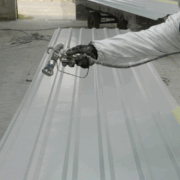
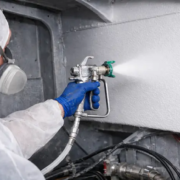
For products in the industrial line, the application method consists of multiple coats using an airless sprayer, following the installation manual.
Are AES TECH and Technological M also suitable for other industrial applications?
Yes, also for containers, silos, metal equipment, tanks, and cold rooms.
Edited by Eng. Elena Galeotti | Published on April 14, 2026 | Updated on April 14, 2026
For more information about Savenergy.it products and their possible applications in the industrial sector, you can contact us at info@savenergy.it.
 Follow our facebook for video, case history and much more!