Savenergy
  • Link to Facebook
  • Link to Instagram
  • Link to LinkedIn
  • Link to Youtube
  • HOME
  • ABOUT
    • MISSION
    • ISO 9001 CERTIFICATIONS
    • PRESS AREA
  • PRODUCTS
    • BUILDING PRODUCTS
      • THERMAL INSULATION FOR BUILDINGS
        • EXTERNAL FACADE INSULATION
        • INTERIOR THERMAL INSULATION
        • INSULATION OF HISTORIC BUILDINGS
        • INSULATION OF HORIZONTAL SURFACES
        • THE VERSIONS OF MANTI CERAMIC
        • OUR APPLICATIONS
        • FAQ
      • CERTIFIED CYCLE MANTI CERAMIC
      • BUILDING MOISTURE SOLUTIONS
      • PHOTOCAT PAINT
      • PHOTOVOLTAIC CONSTRUCTION
      • GEOTHERMAL FOR COSTRUCTION
    • INDUSTRIAL PRODUCTS
      • THERMAL INSULATION
        • MARINE INDUSTRY
        • TRANSPORT AND CONTAINERS
        • WAREHOUSES AND STORES
        • INDUSTRIAL PIPING
        • STORAGE TANKS AND SILOS
        • PETROCHEMICALS AND REFINERIES
        • COLD ROOMS
        • OTHER INDUSTRIAL APPLICATIONS
      • PHOTOVOLTAIC INDUSTRY
      • GEOTHERMAL INDUSTRY
  • DOWNLOAD
    • DATA SHEETS
    • CERTIFICATIONS
  • TRAINING AND ASSISTANCE
    • CONFERENCS AND SEMINARS
    • ON-SITE ASSISTANCE
    • APPLICATORS COURSES
  • BECOME A PARTNER
  • CONTACTS
  • NEWS
  • Manti
  • Menu Menu
  • HOME
  • ABOUT US
    • ISO 9001 CERTIFICATIONS
    • MISSION
    • PRESS AREA
  • PRODUCTS
    • BUILDING PRODUCTS
      • THERMAL INSULATION FOR BUILDINGS
        • EXTERNAL FACADE INSULATION
        • INTERIOR THERMAL INSULATION
        • INSULATION OF HISTORIC BUILDINGS
        • INSULATION OF HORIZONTAL SURFACES
        • THE VERSIONS OF MANTI CERAMIC
        • OUR APPLICATIONS
        • FAQ
      • CERTIFIED CYCLE MANTI CERAMIC
      • BUILDING MOISTURE SOLUTIONS
      • PHOTOCAT PAINT
      • PHOTOVOLTAIC CONSTRUCTION
      • GEOTHERMAL FOR COSTRUCTION
    • INDUSTRIAL PRODUCTS
      • THERMAL INSULATION
        • THERMAL INSULATION FOR MARINE INDUSTRY
        • TRANSPORT AND CONTAINERS
        • WAREHOUSES AND STORES
        • INDUSTRIAL PIPING
        • STORAGE TANKS AND SILOS
        • PETROCHEMICALS AND REFINERIES
        • COLD ROOMS
        • OTHER INDUSTRIAL APPLICATIONS
      • PHOTOVOLTAIC
      • GEOTHERMAL
  • DOWNLOAD
    • Data Sheets
    • Certifications
  • TRAINING AND ASSISTANCE
    • CONFERENCES AND SEMINARS
    • ON-SITE ASSISTANCE
    • APPLICATORS COURSES
  • BECOME A PARTNER
  • CONTACTS
  • NEWS
  • MANTI

Thermal Bridges: How to Eliminate Them with Manti Ceramic in Internal and External Insulation

Thermal Bridges: How to Eliminate Them with Manti Ceramic in Internal and External Insulation

Summary: Thermal bridges are one of the main causes of energy loss in buildings. These discontinuities in the building envelope create cold surfaces, condensation, and mold, compromising indoor comfort and health. Eliminating thermal bridges is therefore essential to improve building energy efficiency. Today, thanks to nanotechnology applied to construction, it is possible to intervene with innovative systems such as the Manti Ceramic micro-coating, which allows thermal bridges to be corrected from both the interior and exterior with minimal thickness.

Contents

  • The limits of traditional insulation systems
  • Thermal bridges and nanotechnology
  • Why Manti Ceramic is ideal for correcting critical insulation points
  • Practical applications: internal and external insulation
  • Technical insights
  • Advantages of correcting thermal bridges
  • Technical glossary
  • FAQ

What Are Thermal Bridges?

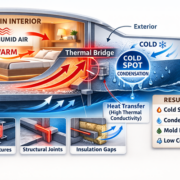
Thermal bridges are areas of the building envelope where heat flow is greater than in the surrounding surfaces.

This phenomenon occurs when wall insulation is not continuous or when structural elements with higher thermal conductivity interrupt the insulation layer.

Critical insulation points are commonly found at:

  • reinforced concrete beams and columns
  • balconies and floor slabs
  • window reveals
  • wall-to-roof junctions
  • structural joints

In many existing buildings, these critical insulation points are among the main causes of energy loss and mold formation.

Thermal bridges in buildings: examples on balconies, columns, and window reveals
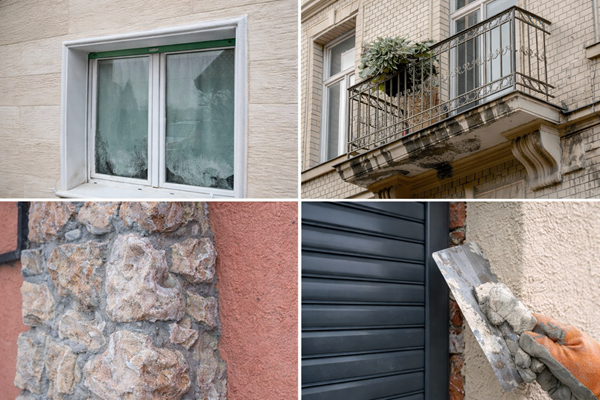
examples of thermal bridges in buildings and application of Manti Ceramic on a window reveal

Examples of thermal bridges in buildings such as windows, balconies and wall junctions, and application of Manti Ceramic on a window reveal to reduce heat loss.

Why Thermal Bridges Cause Energy Loss

The presence of thermal bridges leads to several technical and economic problems.

Areas affected by thermal bridges disperse more heat than the rest of the wall.

Surface Condensation

Interior surfaces become colder, promoting water vapor condensation.

Mold Growth

Persistent humidity creates ideal conditions for mold development.
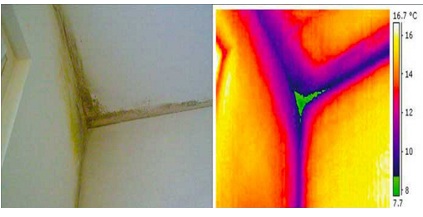
thermal bridges detected with thermography causing mold on an interior wall

Example of thermal bridges detected with thermography that create cold surfaces and cause mold formation on interior walls.

Heating systems must compensate for thermal losses, increasing energy consumption.

For this reason, modern building design increasingly focuses on reducing or eliminating thermal bridges.

The Limits of Traditional Insulation Systems in Reducing Thermal Bridges

Traditional external insulation systems are widely used to improve building energy efficiency. However, they present several limitations when addressing thermal bridges:

      • highthickness (8–16 cm)
      • difficulty of application in construction junctions
      • invasive interventions on façades
      • difficulties with internal insulation due to thickness

Moreover, elements such as balconies, columns, and window reveals are often impossible to insulate effectively with traditional panels.

For these reasons, many professionals are looking for more flexible solutions to correct thermal bridges.

Thermal Bridges and Nanotechnology

In recent years, material innovation has led to the development of nanotechnology-based insulation materialswith thermo-reflective properties.

These materials do not work only by increasing thermal resistance but also by blocking part of the thermal wave.

In the case of Manti Ceramic, the structure contains vacuum ceramic microspheres that help reduce heat transfer and improve insulation efficiency.

This technology allows critical insulation points to be treated with much smaller thicknesses compared to traditional systems.

Why Manti Ceramic Is Ideal for Correcting Critical Insulation Points
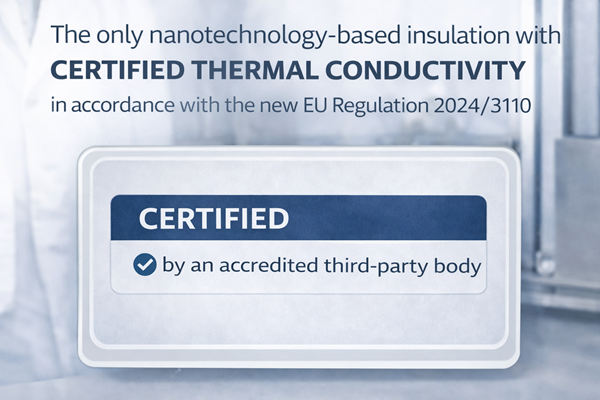
</yoastmarknanotechnology insulation Manti Ceramic with certified thermal conductivity designed to reduce thermal bridges

The Manti Ceramic micro-coating represents a particularly effective solution for reducing <strong>thermal bridging.

Among its main advantages are:

Extremely Low Thermal Conductivity

Manti Ceramic High Density

λ = 0.001 W/mK for thicknesses from 1 to 3 mm
λ = 0.002 W/mK (rounded value) for thicknesses from 4 to 10 mm

Manti Ceramic Medium Density

λ = 0.001 W/mK

Reduced Thickness

The insulation system can be applied with only a few millimeters of material.

Versatile Application

It can be applied both inside and outside buildings.

Adaptability to Construction Details

Ideal for window reveals, beams, columns, and balcony undersides.

Mold and Condensation Prevention

Increasing surface temperature reduces the risk of condensation.

Thanks to these characteristics, <strong>thermal bridges can be corrected even in the most difficult areas of the building envelope.

Thermal bridge with mold formation on the interior wall of a building</p>

Practical Applications: Internal and External Insulation

One of the main advantages of Manti Ceramic is its application flexibility.

External Insulation

The product can be applied as an alternative or complement to traditional external insulation to correct critical façade insulation points.

Thermal bridge under a terrace with heat loss through the balcony slab

Internal Insulation

In many condominium buildings or historic properties, interventions on external façades are not possible. In these cases, internal insulation becomes an effective solution.

Thanks to its minimal thickness, Manti Ceramic can reduce thermal bridging without compromising living space.

Technical Insight

From a building physics perspective, critical insulation points represent a local variation in the thermal resistance of the building envelope.

The thermal transmittance of a wall is calculated with the formula:

U = 1 / Rt

where Rt represents the total thermal resistance of the wall assembly.

When materials with high thermal conductivity (such as reinforced concrete) interrupt the insulation layer, heat flow increases and a thermal bridge is created.

Advantages of Correcting Thermal Bridges

  • reduction of energy losses
  • improved indoor comfort
  • prevention of mold formation
  • longer durability of walls and structures
  • improvement of the building energy class

Glossary

  1. Thermal bridge
    An area of the building envelope where heat flow is higher.
  2. Thermal transmittance
    The amount of heat passing through a surface.
  3. Thermal reflectance
    The ability of a material to reflect thermal energy.
  4. Thermal phase shift
    he time required for heat to pass through a building structure.

FAQ

What are thermal bridges?

They are critical insulation points where heat escapes more easily due to discontinuities in the insulation layer. They are often found at balconies, columns, beams, window reveals, and structural junctions.

Do thermal bridges cause mold?

Yes. Cold surfaces created by thermal bridges encourage condensation and mold growth.

Can thermal bridges be corrected from the inside?

Yes, using low-thickness insulation systems such as nanotechnology coatings.

Can Manti Ceramic eliminate thermal bridges?

The Manti Ceramic micro-coating allows them to be effectively corrected thanks to its versatile application and minimal thickness.

Conclusion – Manti Ceramic, the Insulation that Eliminates Thermal Bridging

Critical insulation points are one of the main challenges in building energy efficiency. Identifying and correcting them is essential to improve indoor comfort, reduce energy consumption, and prevent mold formation.

Thanks to nanotechnology applied to construction, innovative systems such as Manti Ceramic make it possible to intervene even in the most complex construction details with effective and minimally invasive solutions.

📩 For more information you can contact us at:
info@savenergy.it

📹 Follow our facebook for video, case history and much more!

Eng. Elena Galeotti
Savenergy.it Srl
Share this entry
  • Share on Facebook
  • Share on WhatsApp
  • Share on LinkedIn
  • Share by Mail
https://www.savenergy.it/wp-content/uploads/2026/03/thermal-bridges.png 400 600 Elena https://savenergy.it/wp-content/uploads/2024/04/Logo-Savenergy.png Elena2026-03-12 10:57:582026-03-12 11:39:12Thermal Bridges: How to Eliminate Them with Manti Ceramic in Internal and External Insulation
You might also like
Thermal bridges in yachts: the hidden cause of condensation and poor cabin comfort
Flange insulation: low-thickness nanotechnology coating for critical plant points

Ultime Notizie

  • Thermal Insulation on Metal: The Infrared Test on Maris Tech18 May 2026 - 10:39in: Uncategorized
  • Flange insulation: low-thickness nanotechnology coating for critical plant points4 May 2026 - 14:30in: News
  • Low-Thickness Marine Insulation: How Maris Tech Solves the Trade-Off Between Thermal Performance, Weight, and Bulk21 April 2026 - 15:10in: News
  • Dairy Industry Piping: Why a Low-Thickness Thermal Coating Can Make a Difference14 April 2026 - 17:33in: News
  • Insulation for Industrial Buildings: how to improve comfort, protection and condensation control with AES TECH and Technological M3 April 2026 - 12:52in: News
  • Thermal bridges in yachts: the hidden cause of condensation and poor cabin comfort16 March 2026 - 10:32in: News
  • Thermal Bridges: How to Eliminate Them with Manti Ceramic in Internal and External Insulation12 March 2026 - 10:57in: News
  • Maris Tech and Anti-Condensation Protection in Metal Hulls: Invisible Insulation for Modern Marine Applications17 February 2026 - 10:37in: News
  • Thermal Insulation for Modular Containers: The AES TECH Nanoceramic Solution13 February 2026 - 13:14in: News
  • Insulation and Waterproofing of Warehouse Roofs with a Single Product: Technological M2 February 2026 - 11:00in: News

Savenergy.it Srl

Via Andrea Doria 56, 20124 Milano

contatti@savenergy.it – PEC: savenergy.it@pec.it


Conditions of sale

Reserved area

Savenergy.it Srl | P. IVA 01733570335 - CCIAA: 2960/2017 REA: MI – 2632526
  • Cookie Policy
  • Privacy Policy
Link to: Maris Tech and Anti-Condensation Protection in Metal Hulls: Invisible Insulation for Modern Marine Applications Link to: Maris Tech and Anti-Condensation Protection in Metal Hulls: Invisible Insulation for Modern Marine Applications Maris Tech and Anti-Condensation Protection in Metal Hulls: Invisible Insulation... Link to: Thermal bridges in yachts: the hidden cause of condensation and poor cabin comfort Link to: Thermal bridges in yachts: the hidden cause of condensation and poor cabin comfort Thermal bridges in yachts: the hidden cause of condensation and poor cabin ...
Scroll to top Scroll to top Scroll to top
Accessibility Adjustments

Powered by OneTap

Impegno per l'accessibilità di Savenergy SRL

Presso Savenergy SRL, ci impegniamo a rendere la nostra presenza digitale il più accessibile e inclusiva possibile per tutti gli utenti, comprese le persone con disabilità. Il nostro obiettivo è migliorare l'usabilità di www.savenergy.it e supportare un'esperienza più accessibile per tutti, indipendentemente dalle capacità o dalle tecnologie utilizzate.

Il nostro approccio all'accessibilità

Cerchiamo di allinearci alle Linee guida per l'accessibilità dei contenuti web (WCAG), che definiscono standard riconosciuti a livello internazionale per l'accessibilità digitale. Sebbene non sia sempre possibile garantire la piena conformità, ci impegniamo ad apportare miglioramenti quando possibile e a rivedere regolarmente gli aspetti legati all'accessibilità del nostro sito. L'accessibilità è un processo continuo, e ci impegniamo a migliorare l'esperienza nel tempo, man mano che evolvono tecnologie, standard ed esigenze degli utenti.

Funzionalità di accessibilità

Per supportare l'accessibilità, www.savenergy.it può utilizzare strumenti come la barra di accessibilità OneTap. Questa interfaccia offre una serie di funzionalità utili, tra cui:
  • Dimensioni del testo e impostazioni di contrasto regolabili
  • Evidenziazione di collegamenti e testi per una migliore visibilità
  • Navigazione completa da tastiera dell'interfaccia
  • Avvio rapido tramite scorciatoia da tastiera: Alt + . (Windows) o ⌘ + . (Mac)
Si prega di notare quanto segue:
  • La disponibilità e l'efficacia di queste funzionalità dipendono dalla configurazione del sito e dalla sua manutenzione continua.
  • Nonostante i nostri sforzi per garantire l’accessibilità, non possiamo assicurare che tutte le parti di www.savenergy.it siano sempre completamente accessibili. Alcuni contenuti potrebbero essere forniti da terze parti o influenzati da limitazioni tecniche al di fuori del nostro controllo.

Feedback e contatti

Accogliamo con piacere i vostri feedback. Se riscontrate barriere all'accessibilità o avete suggerimenti per miglioramenti, vi preghiamo di contattarci: Email: info@savenergy.it Siamo impegnati a esaminare tutte le richieste e a rispondere entro 3–5 giorni lavorativi. Se avete bisogno di assistenza per accedere a qualsiasi parte di questo sito web, saremo lieti di fornirla tramite canali alternativi su richiesta. Ultimo aggiornamento: 5 luglio 2025
How long do you want to hide the toolbar?
Hide Toolbar Duration
Select your accessibility profile
Vision Impaired Mode
Enhances website's visuals
Seizure Safe Profile
Clear flashes & reduces color
ADHD Friendly Mode
Focused browsing, distraction-free
Blindness Mode
Reduces distractions, improves focus
Epilepsy Safe Mode
Dims colors and stops blinking
Content Modules
Font Size

Default

Line Height

Default

Color Modules
Orientation Modules

Chatta con noi