
Thermal bridges in yachts: the hidden cause of condensation and poor cabin comfort
Quick summary: if you experience condensation, cold walls, or uneven temperatures inside yacht cabins, the problem is often thermal bridges in yachts. These hidden weak points in the hull allow heat to transfer rapidly, reducing comfort and increasing moisture issues. Understanding how they work—and how to fix them—is essential in modern yacht refitting.
What are thermal bridges in yachts?
Thermal bridges in yachts are areas of the structure where heat flows faster than in surrounding surfaces.
They occur when materials with high thermal conductivity—such as metal reinforcements or structural connections—create a direct path for heat transfer between the exterior and interior.
👉 The result?
Cold internal surfaces, even when the cabin is heated.
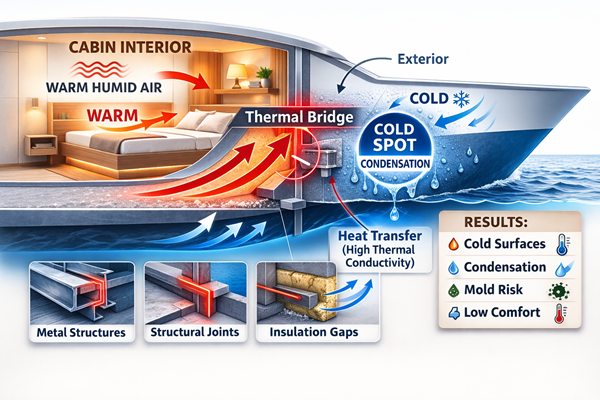
Diagram showing how thermal bridges in yachts create condensation and reduce cabin comfort, solved with advanced insulation solutions
Why thermal bridges are so common in yachts
Unlike buildings, yachts are not primarily designed for thermal insulation.
They are built for:
- structural strength
- weight reduction
- mechanical performance
👉 Thermal comfort is often secondary.
This makes thermal bridges in yachts extremely common, especially in older vessels or refitting projects.
Main causes of thermal bridges in yacht cabins
🔩 Metal structural elements
Frames, ribs, and reinforcements act as heat conductors, transferring cold directly inside.
🌊 Direct contact with seawater
The hull is constantly cooled by water, making internal surfaces colder than cabin air.
📏 Thin structures
To reduce weight, hull thickness is limited—resulting in low thermal resistance.
🔗 Structural junctions
Connections between hull, deck, and bulkheads often create insulation gaps.
🪟 Portholes and windows
Metal frames without thermal break easily transmit cold.
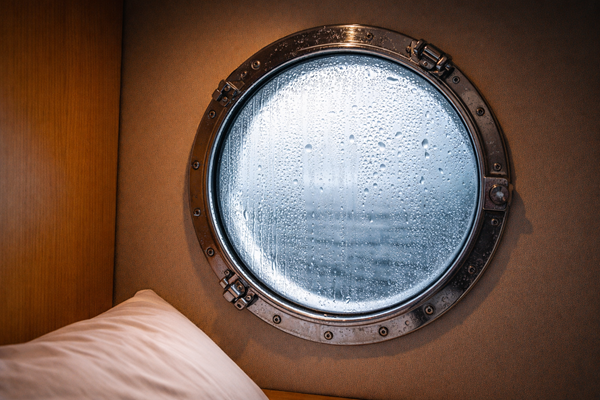
Condensation forming on a yacht porthole due to thermal bridges in the hull and cold internal surfaces
⚠️ Insulation gaps
Traditional panel insulation often leaves voids, reducing effectiveness.
What problems do thermal bridges cause?
Thermal bridges in yachts directly impact onboard comfort:
❌ Cold walls and surfaces
❌ Condensation formation
❌ Risk of mold and moisture damage
❌ Uneven cabin temperatures
👉 These issues are especially noticeable in cabins close to the hull.
Why thermal bridges matter in yacht refitting
During refitting, these problems often emerge clearly.
This is because:
- original insulation was minimal
- materials degrade over time
- thermal performance was not a design priority
👉 And here’s the key limitation:
You cannot modify the hull structure.
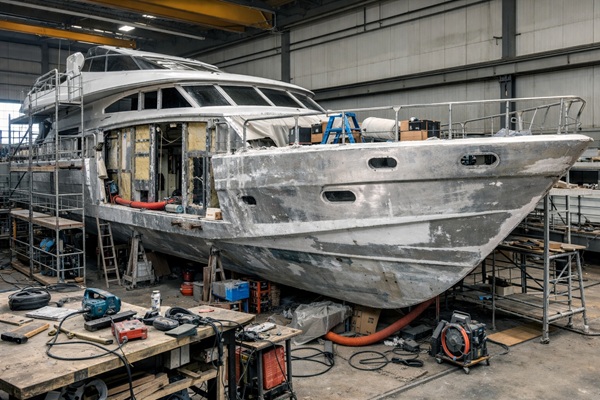
Yacht refitting phase where thermal bridges in the hull are identified and treated to improve insulation and onboard comfort
How to solve thermal bridges without structural changes
Since structural intervention is not feasible, the solution is:
👉 improving the thermal behavior of internal surfaces
This is where advanced technologies come into play.
Advanced solution: ceramic thermal coatings
Modern systems based on ceramic microspheres, such as Maris Tech by Savenergy, are specifically developed to address thermal bridges in yachts.
These coatings:
✔️ reduce heat transfer
✔️ increase internal surface temperature
✔️ limit condensation formation
✔️ improve overall cabin comfort
👉 All with minimal thickness (1–4 mm)
Unlike traditional insulation panels, they:
-
adapt perfectly to complex geometries
-
eliminate discontinuities
-
require no structural intervention
Why Maris Tech stands out
Not all solutions are the same.
Maris Tech by Savenergy is designed to:
- thermal insulation in marine applications
- effectively reduce thermal bridges in yachts
- work on multiple heat transfer mechanisms
- offer extremely low thermal conductivity (up to 0.001 W/mK)
👉 making it particularly suitable for refitting projects where space and structure are critical constraints.
How to reduce thermal bridges in yachts
Effective strategies include:
- improving internal insulation performance
- reducing surface thermal conductivity
- eliminating thermal discontinuities
👉 In many cases, thin ceramic coatings like Maris Tech represent the most efficient and practical solution.
FAQ – Thermal bridges in yachts
What are thermal bridges in yachts?
Areas where heat transfer is higher due to structural or material discontinuities.
Do thermal bridges cause condensation?
Yes. Cold surfaces can fall below dew point, leading to moisture formation.
Can thermal bridges be solved without major works?
Yes. Advanced solutions like Maris Tech can significantly reduce their impact without modifying the structure.
Conclusion
Thermal bridges in yachts are one of the main hidden causes of discomfort and condensation onboard.
As yacht refitting evolves, the focus is shifting:
👉 from structural modification
👉 to surface performance optimization
Technologies like ceramic thermal coatings provide a practical, non-invasive, and highly effective solution to improve comfort and energy efficiency.
Contact us
For technical information or project support:
📩 info@savenergy.it
 Follow our facebook for video, case history and much more!
Author
Eng. Elena Galeotti
Thermal insulation specialist – Savenergy.it

