Thermal Bridges: How to Eliminate Them with Manti Ceramic in Internal and External Insulation
Summary: Thermal bridges are one of the main causes of energy loss in buildings. These discontinuities in the building envelope create cold surfaces, condensation, and mold, compromising indoor comfort and health. Eliminating thermal bridges is therefore essential to improve building energy efficiency. Today, thanks to nanotechnology applied to construction, it is possible to intervene with innovative systems such as the Manti Ceramic micro-coating, which allows thermal bridges to be corrected from both the interior and exterior with minimal thickness.
Contents
- The limits of traditional insulation systems
- Thermal bridges and nanotechnology
- Why Manti Ceramic is ideal for correcting critical insulation points
- Practical applications: internal and external insulation
- Technical insights
- Advantages of correcting thermal bridges
- Technical glossary
- FAQ
What Are Thermal Bridges?
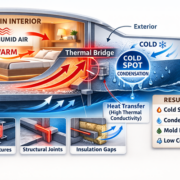
Thermal bridges are areas of the building envelope where heat flow is greater than in the surrounding surfaces.
This phenomenon occurs when wall insulation is not continuous or when structural elements with higher thermal conductivity interrupt the insulation layer.
Critical insulation points are commonly found at:
- reinforced concrete beams and columns
- balconies and floor slabs
- window reveals
- wall-to-roof junctions
- structural joints
In many existing buildings, these critical insulation points are among the main causes of energy loss and mold formation.
Thermal bridges in buildings: examples on balconies, columns, and window reveals
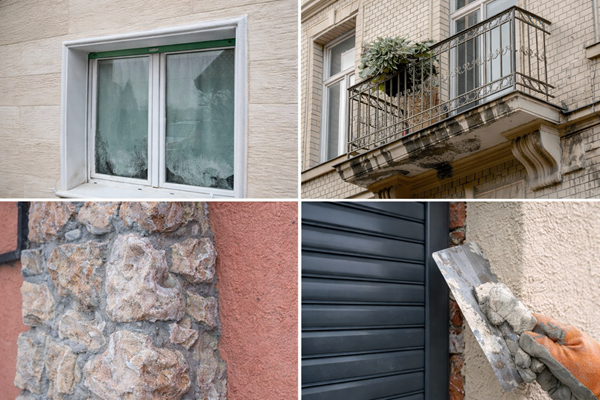
Examples of thermal bridges in buildings such as windows, balconies and wall junctions, and application of Manti Ceramic on a window reveal to reduce heat loss.
Why Thermal Bridges Cause Energy Loss
The presence of thermal bridges leads to several technical and economic problems.
Areas affected by thermal bridges disperse more heat than the rest of the wall.
Surface Condensation
Interior surfaces become colder, promoting water vapor condensation.
Mold Growth
Persistent humidity creates ideal conditions for mold development.
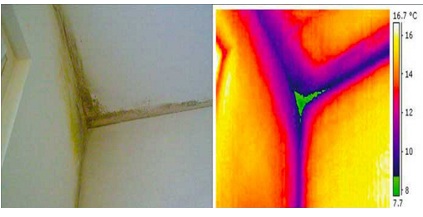
Example of thermal bridges detected with thermography that create cold surfaces and cause mold formation on interior walls.
Heating systems must compensate for thermal losses, increasing energy consumption.
For this reason, modern building design increasingly focuses on reducing or eliminating thermal bridges.
The Limits of Traditional Insulation Systems in Reducing Thermal Bridges
Traditional external insulation systems are widely used to improve building energy efficiency. However, they present several limitations when addressing thermal bridges:
-
-
- difficulty of application in construction junctions
- invasive interventions on façades
- difficulties with internal insulation due to thickness
Moreover, elements such as balconies, columns, and window reveals are often impossible to insulate effectively with traditional panels.
For these reasons, many professionals are looking for more flexible solutions to correct thermal bridges.
Thermal Bridges and Nanotechnology
In recent years, material innovation has led to the development of nanotechnology-based insulation materialswith thermo-reflective properties.
These materials do not work only by increasing thermal resistance but also by blocking part of the thermal wave.
In the case of Manti Ceramic, the structure contains vacuum ceramic microspheres that help reduce heat transfer and improve insulation efficiency.
This technology allows critical insulation points to be treated with much smaller thicknesses compared to traditional systems.
Why Manti Ceramic Is Ideal for Correcting Critical Insulation Points
 nanotechnology insulation Manti Ceramic with certified thermal conductivity designed to reduce thermal bridges
The Manti Ceramic micro-coating represents a particularly effective solution for reducing <strong>thermal bridging.
Among its main advantages are:
Manti Ceramic High Density
λ = 0.001 W/mK for thicknesses from 1 to 3 mm
λ = 0.002 W/mK (rounded value) for thicknesses from 4 to 10 mm
Manti Ceramic Medium Density
λ = 0.001 W/mK
Reduced Thickness
The insulation system can be applied with only a few millimeters of material.
Versatile Application
It can be applied both inside and outside buildings.
Adaptability to Construction Details
Ideal for window reveals, beams, columns, and balcony undersides.
Mold and Condensation Prevention
Increasing surface temperature reduces the risk of condensation.
Thanks to these characteristics, <strong>thermal bridges can be corrected even in the most difficult areas of the building envelope.
Thermal bridge with mold formation on the interior wall of a building</p>
Practical Applications: Internal and External Insulation
One of the main advantages of Manti Ceramic is its application flexibility.
External Insulation
The product can be applied as an alternative or complement to traditional external insulation to correct critical façade insulation points.
Thermal bridge under a terrace with heat loss through the balcony slab
Internal Insulation
In many condominium buildings or historic properties, interventions on external façades are not possible. In these cases, internal insulation becomes an effective solution.
Thanks to its minimal thickness, Manti Ceramic can reduce thermal bridging without compromising living space.
Technical Insight
From a building physics perspective, critical insulation points represent a local variation in the thermal resistance of the building envelope.
The thermal transmittance of a wall is calculated with the formula:
U = 1 / Rt
where Rt represents the total thermal resistance of the wall assembly.
When materials with high thermal conductivity (such as reinforced concrete) interrupt the insulation layer, heat flow increases and a thermal bridge is created.
Advantages of Correcting Thermal Bridges
- reduction of energy losses
- improved indoor comfort
- prevention of mold formation
- longer durability of walls and structures
- improvement of the building energy class
Glossary
- Thermal bridge
An area of the building envelope where heat flow is higher.
- Thermal transmittance
The amount of heat passing through a surface.
- Thermal reflectance
The ability of a material to reflect thermal energy.
- Thermal phase shift
he time required for heat to pass through a building structure.
FAQ
What are thermal bridges?
They are critical insulation points where heat escapes more easily due to discontinuities in the insulation layer. They are often found at balconies, columns, beams, window reveals, and structural junctions.
Do thermal bridges cause mold?
Yes. Cold surfaces created by thermal bridges encourage condensation and mold growth.
Can thermal bridges be corrected from the inside?
Yes, using low-thickness insulation systems such as nanotechnology coatings.
Can Manti Ceramic eliminate thermal bridges?
The Manti Ceramic micro-coating allows them to be effectively corrected thanks to its versatile application and minimal thickness.
Conclusion – Manti Ceramic, the Insulation that Eliminates Thermal Bridging
Critical insulation points are one of the main challenges in building energy efficiency. Identifying and correcting them is essential to improve indoor comfort, reduce energy consumption, and prevent mold formation.
Thanks to nanotechnology applied to construction, innovative systems such as Manti Ceramic make it possible to intervene even in the most complex construction details with effective and minimally invasive solutions.
📩 For more information you can contact us at:
info@savenergy.it
 Follow our facebook for video, case history and much more!
Eng. Elena Galeotti
Savenergy.it Srl