Thermal Insulation of Industrial Tanks: Heat Loss, Condensation, and Inspection Accessibility
Summary: Thermal insulation for industrial tanks is not just about reducing energy loss. In metal tanks, it is also necessary to consider condensation, the risk of Corrosion Under Insulation (CUI), exposure to atmospheric agents, and the need for periodic inspections of the structure. Thin-film nanotechnological insulating coatings represent an interesting solution, especially when complex geometries, limited space, and maintenance requirements make bulky insulation systems impractical.
Table of Contents
-
Why thermally insulate an industrial tank
-
Heat loss and temperature fluctuations
-
Condensation and corrosion under insulation
-
Why accessibility for inspections is important
-
Thin-film nanotechnological insulation
-
How to properly design the intervention
-
FAQs on industrial tank insulation
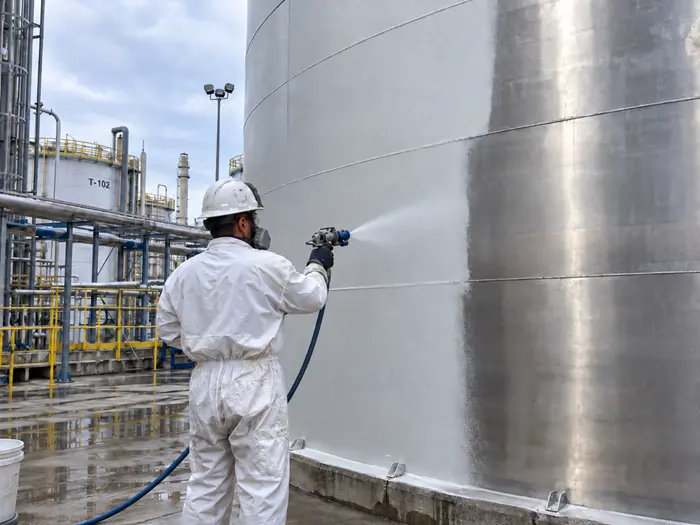
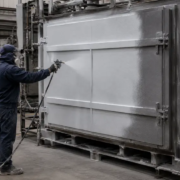
Spray application of the thin-layer thermal insulation coating Aes Tech on the metal surface of an industrial storage tank.
Why Thermal Insulation of Industrial Tanks Requires a Specific Approach
A storage tank is not simply a large metal surface to be insulated. The temperature of the contained product, external weather conditions, solar exposure, humidity, thermal cycles, and maintenance requirements make every intervention unique.
Therefore, thermal insulation of industrial tanks must be evaluated by simultaneously considering heat loss or heat gain containment, surface protection, and subsequent inspection needs.
In tanks containing hot products, limiting outward heat flux helps maintain a more stable process temperature. Conversely, in tanks containing cold products, the goal is often to restrict heat entry from the surrounding environment and control the conditions that favor condensation formation.
Savenergy.it’s thin-film nanotechnological insulation solutions are applied to liquid tanks, return tanks, boilers, condensate lines, heat exchangers, and storage silos.
Heat Loss: It Is Not Just About Thickness
When a temperature difference exists between the tank’s contents and the outside environment, heat transfer inevitably occurs.
On large structures, even a relatively low heat loss per square meter can become significant when considering the total surface area of the tank.
For this reason, insulation evaluation should not stop at material thickness alone. System thermal characteristics, operating temperatures, solar radiation, metal substrates, exposure conditions, and coating continuity must also be taken into account.
Savenergy.it industrial solutions utilize coatings containing hollow ceramic microspheres and are designed to achieve thermal protection with very low thicknesses. AES Tech, for example, has an application thickness of approximately 1–4 mm.
The advantage of a low thickness becomes particularly compelling in complex areas: joints, supports, welds, connections, and irregularly shaped surfaces.
Condensation on Tanks: When Does It Form?
A second critical issue is condensation.
When the temperature of a metal surface drops below the dew point of the surrounding air, water vapor can condense on the surface.
In an industrial facility, this condition must not be overlooked. The prolonged presence of moisture near the metal creates favorable conditions for corrosive phenomena.
The issue escalates when water penetrates underneath an insulation system and remains trapped between the insulation and the metal surface.
Corrosion Under Insulation: The Problem of CUI
This is where Corrosion Under Insulation—commonly referred to by the acronym CUI—comes into play.
CUI is the corrosion that develops on metal surfaces beneath an insulation system. It is particularly insidious because the degradation may not be immediately visible from the outside.
AMPP emphasizes that moisture, insulation condition, protective coatings, thermal cycles, and outer jacket integrity are all key factors to consider when managing CUI risk.
The topic is significant enough to be addressed by API Recommended Practice 583 – Corrosion Under Insulation and Fireproofing, which reached its third edition in 2026. This Recommended Practice covers design, maintenance, inspection, and CUI mitigation, and explicitly includes storage tanks among the affected equipment.
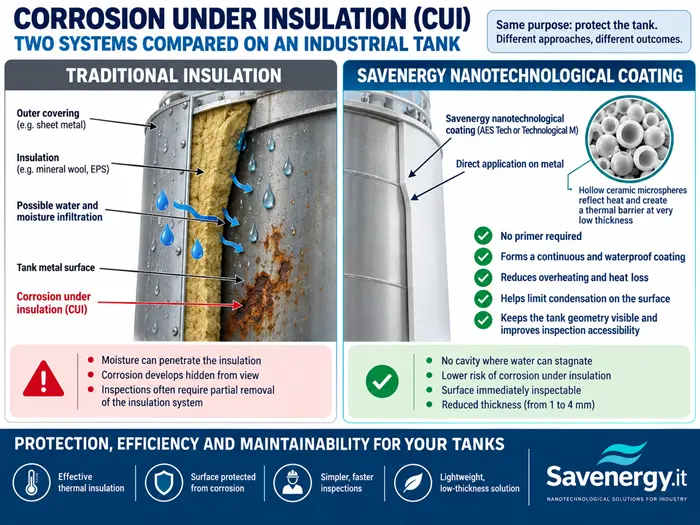
Comparison between traditional tank insulation and a Savenergy.it nanotechnological coating applied directly to the metal surface, highlighting differences related to moisture, CUI and inspection accessibility.
Traditional Insulation Systems and Corrosion Risks
Traditional insulation systems can promote corrosion, as water and contaminants frequently manage to penetrate the system and reach the underlying metal.
Industrial Tank Thermal Insulation and Inspection Accessibility
This aspect is sometimes overlooked when choosing an insulation system. An industrial tank must remain accessible for inspection and ongoing maintenance.
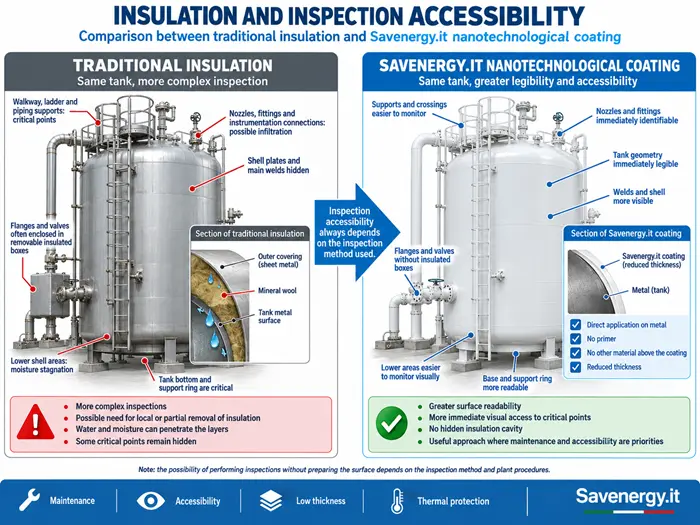
Technical comparison between traditional insulation and Savenergy.it nanotechnological coating, highlighting inspection accessibility on industrial tanks and critical components.
Traditional insulation systems can comprise multiple elements—insulating material, fasteners, moisture barriers, and external cladding—and, depending on the required inspection type, localized opening or removal may be necessary to reach the underlying metal surface.
A thermal insulation coating applied directly to the substrate transforms this scenario: it creates no hidden cavity between the insulation panel and the sheet metal, leaving the tank’s geometry immediately visible from the outside.
This provides a significant advantage for maintenance programs.
However, this does not mean that every inspection can be carried out without affecting the coating. The ability to perform non-destructive testing (NDT) through a coating depends on the specific inspection technique, material, thickness, and plant procedures. API RP 583 itself pays close attention to the capabilities and limitations of various non-destructive examination methods.
For this reason, inspection accessibility must be addressed during the design phase, not just when maintenance is due.
Nanotechnological Coatings for Thermal insulation of Industrial Tanks
In the field of industrial tank thermal insulation, thin-film technologies are particularly useful when combining insulation performance, seamless continuity, and geometric simplicity.
AES Tech by Savenergy.it is a water-based coating containing hollow ceramic microspheres. Designed for thin-film application, it is specifically intended for industrial tanks and silos.
AES TECH Key Technical Data:
-
Thickness: Approx. 1.0 – 5.0 mm
-
Thermal Conductivity: λd = (HotBox Test) 0.0010 W/mK
-
Solar Reflectance (SR %) (ASTM C1549): 84.3
-
Thermal Emissivity (IE %) (EN 15976): 87.4
-
Solar Reflectance Index (SRI %) (ASTM E1980): 105
-
VOC Content: < 0.003 μg/L (UNI EN ISO 16000-9:2024, 16000-6:2021, 16000-3:2022)
-
Reaction to Fire: Euroclass A
-
Pull-off Test: >2 on substrate; 0.55 ± 0.10 N/mm² layer-to-layer (ASTM D4541)
-
Maximum Operating Temperature: 240 °C
Technological M Key Technical Data:
-
Thickness: Approx. 0.6 – 1.0 mm
-
Thermal Conductivity: λd = 0.001 W/mK
-
Solar Reflectance (SR %) (ASTM C1549): 88.1
-
Thermal Emissivity (IE %) (EN 15976): 85.8
-
Solar Reflectance Index (SRI %) (ASTM E1980): 111.1
-
Maximum Operating Temperature: 180 °C
-
Corrosion Protection: Class C4 (Class C5 by adding TopCoat and Primer Manti Anticorrosion) – ISO 12944
-
Water Permeability: Class W3, 0.0754 kg/(m²h⁰·⁵) (UNI EN 1062-3)
The Savenergy.it industrial line is applied primarily via Airless spray systems, allowing seamless application over curved surfaces, fittings, and complex shapes without requiring pre-formed panels.
For storage tanks, this is especially beneficial on large surface areas or structural details that are difficult to insulate with rigid systems.
Download Savenergy.it Product Technical Datasheets
Research on thermal-insulating coatings has investigated the use of hollow microspheres as functional fillers for reducing heat transfer on industrial equipment and piping, while also considering the corrosion performance of the coating system.
Does an Insulating Coating Eliminate CUI Risk?
Yes, an insulating coating such as AES Tech or Technological M significantly reduces CUI risk.
The key benefit of a coating bonded directly to the substrate is that it eliminates the conditions typical of conventional systems, where moisture can penetrate and remain trapped underneath the insulation layer.
However, proper engineering design must still account for the substrate material, surface condition, operating temperatures, ambient environment, and planned maintenance procedures.
How to Choose Thermal Insulation for an Industrial Tank
Before selecting a solution, it is essential to determine fluid temperature, operating thermal range, ambient temperature and humidity, solar exposure, tank material, surface condition, existing corrosion issues, and the thermal target of the project.
Based on this data, the most appropriate coating cycle can be specified and verified for the specific application.
This step converts insulation from a simple outer coating into an integrated component of the plant’s thermal efficiency, protection, and maintenance strategy.
Thermal insulation of Industrial Tanks – FAQs
Why thermally insulate an industrial tank?
Insulation reduces heat exchange between the stored product and the environment, helping stabilize operating temperatures and control surface temperatures.
Can insulation help control condensation?
A properly sized system modifies surface temperature and helps manage conditions that lead to condensation. However, verification must consider temperature, relative humidity, and dew point under actual operating conditions.
What is Corrosion Under Insulation (CUI)?
CUI is a corrosive phenomenon that develops on metal surfaces hidden beneath an insulation system, typically in the presence of trapped moisture. It is a major issue in the petrochemical, chemical, and process industries.
How thick should nanotechnological tank insulation be?
It depends on the specific product and project requirements. AES Tech is applied at 1–5 mm, while Technological M ranges from 0.6–2 mm. Required thickness must be calculated for each specific case.
Does a thin-film coating facilitate inspections?
While traditional multilayer systems with removable external jacketing make inspections difficult, thin-film coatings significantly improve accessibility.
A Customized Solution for Every Project
Selecting industrial tank insulation should not be based solely on heat loss reduction.
Heat loss, condensation, CUI risk, tank geometry, and future inspection accessibility must all be evaluated together.
Savenergy.it offers ultra-thin industrial nanotechnological insulation suitable for tanks, silos, piping, and metal equipment.
To determine the most suitable coating cycle for your facility or request technical information, contact us at info@savenergy.it or fill out the form
Eng. Elena Galeotti – 15/09/2026